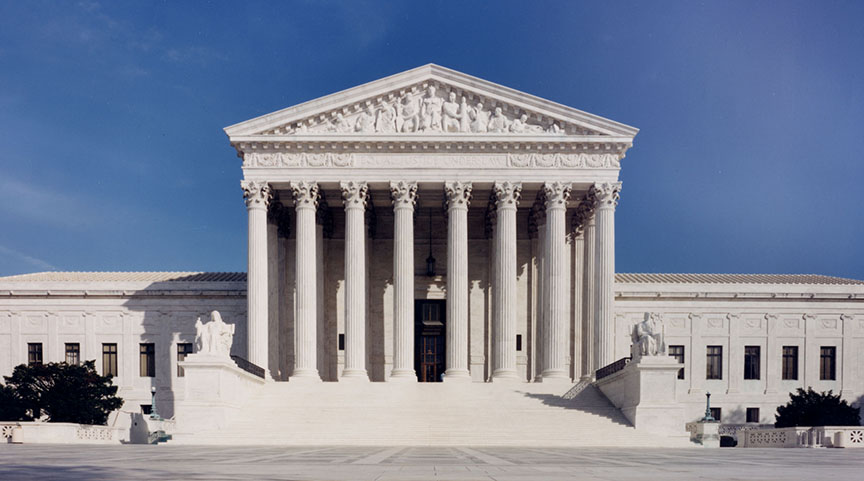
In a seismic ruling that reverberates through the nation's legal and social fabric, the U.S. Supreme Court has decisively rejected a controversial executive order from former President Donald Trump aimed at curtailing birthright citizenship. This landmark 6-3 decision reaffirms that, barring specific exceptions, virtually all individuals born on American soil are automatically granted U.S. citizenship, a principle deeply rooted in the 14th Amendment.
THE STORY The executive order, pushed by the Trump administration, sought to strip citizenship from children born in the U.S. to parents deemed undocumented immigrants or temporary foreign residents. The Supreme Court, in its wisdom, has declared this an overreach, emphasizing the constitutional protection of citizenship. Chief Justice John G. Roberts Jr., penning the majority opinion, underscored the enduring significance of this right, stating, “Citizenship, then and now, was the right to have rights.” He emphatically declared, “We keep that promise today,” signaling a commitment to the foundational principles of the Constitution.
Roberts’ majority opinion was a coalition effort, reportedly including the Court’s three liberal justices alongside conservative appointees Amy Coney Barrett and Brett M. Kavanaugh. Notably, Justice Kavanaugh penned a separate concurring opinion, suggesting that while he agreed with the outcome, the order could have been invalidated on statutory grounds rather than a full constitutional interpretation. This nuanced approach highlights the complex legal arguments surrounding the issue.
Dissent, however, was vocal. Justices Clarence Thomas, Neil M. Gorsuch, and Samuel A. Alito Jr. stood in opposition. Justice Alito, in his dissent, labeled the majority’s decision a “serious mistake,” indicating a sharp divide within the highest court on matters of citizenship law and immigration policy. Following the ruling, Trump himself voiced his displeasure on social media, calling for Congressional action to legislate the issue, a move that signals ongoing political battles.
CONTEXT Birthright citizenship, often referred to as *jus soli* (right of the soil), has been a cornerstone of American legal tradition since the ratification of the 14th Amendment in 1868. The amendment states that “All persons born or naturalized in the United States, and subject to the jurisdiction thereof, are citizens of the United States and of the State wherein they reside.” For decades, this language has been widely interpreted to mean that any child born within U.S. borders, regardless of their parents' immigration status, is entitled to citizenship. However, the Trump administration had challenged this long-standing interpretation, seeking to revise what they argued was an unintended loophole.
This legal battle taps into broader, often fraught, national debates about immigration, national identity, and the scope of constitutional rights. Legal scholars and immigration advocates have frequently pointed to the 1898 Supreme Court case *United States v. Wong Kim Ark* as a key precedent, where the Court affirmed birthright citizenship for a child born to Chinese immigrants who were legally residing in the U.S. Trump’s executive order represented one of the most direct challenges to this precedent in recent history, setting potentially far-reaching implications for millions of families.
WHY IT MATTERS This Supreme Court decision is a profound validation of the 14th Amendment and its promise of equal citizenship. By upholding birthright citizenship, the Court prevents a potentially chaotic and deeply divisive scenario where millions of children born in the U.S. could have been rendered stateless or subjected to prolonged legal uncertainty. It underscores that fundamental rights, especially citizenship, are not easily stripped away by executive fiat and require robust constitutional grounding.
From a cultural perspective, the ruling reinforces the idea of America as a nation built on the principle of being born here, a concept that has shaped our national identity for generations. While political debates around immigration will undoubtedly continue, this ruling sets a clear legal boundary, asserting that the foundational promise of the 14th Amendment remains intact. It’s a significant win for civil rights and a rejection of policies that seek to divide rather than unite.
Reporting via The Source. Read the original story here: https://thesource.com/2026/06/30/supreme-court-rejects-trump-birthright-citizenship/?utm_source=rss&utm_medium=rss&utm_campaign=supreme-court-rejects-trump-birthright-citizenship